
MAPEO DE LA BIBLIOGRAFÍA SOBRE EL BIENESTAR EUDAIMÓNICO: UN ESTUDIO BIBLIOMÉTRICO
DOI:
https://doi.org/10.55028/ejct8958Palabras clave:
Bienestar eudaimónico, Bibliometría, Consumo.Resumen
Objetivo:
El bienestar eudaimónico es un concepto que hace hincapié en la plenitud y el florecimiento definitivos en la vida. Incluye las relaciones positivas, la autonomía, el crecimiento y el propósito. El objetivo de este estudio es trazar un mapa de la bibliografía sobre el bienestar eudaimónico. La pregunta de investigación es la siguiente: ¿Cómo se organiza la bibliografía sobre el bienestar eudaimónico?
Diseño/metodología/enfoque:
Se llevó a cabo un estudio bibliométrico sobre el bienestar eudaimónico, analizando 64 artículos científicos relacionados con este tema en diversos campos de estudio. Los datos se organizaron utilizando VOSviewer©, incorporando principios bibliométricos como la ley de Lotka para medir la productividad de los autores que realizan una contribución significativa a la investigación, la ley de Zipf para medir la frecuencia y la proporción de palabras en los estudios y la ley de Bradford para evaluar la productividad y la relevancia de las revistas científicas.
Resultados:
Este enfoque ayudará a identificar patrones, tendencias y lagunas en la bibliografía relacionada con la influencia del consumo en el bienestar eudaimónico, proporcionando información valiosa para futuras investigaciones en este ámbito.
Originalidad:
Esta investigación ofrece una perspectiva novedosa sobre la relación entre el consumo y el bienestar social de los consumidores al examinar el papel que desempeña el bienestar eudaimónico en el campo de la gestión. Además, el estudio sugiere un diálogo entre las prácticas de bienestar y las teorías de gestión, argumentando que unas prácticas de mercado y unas políticas empresariales más morales y centradas en el bienestar pueden ayudar a lograr un equilibrio entre las demandas sociales y las necesidades individuales.
Referencias
Ahmer, Z., Sheikh, L., bin Umar, H. T., & Rashid, H. A. (2021). Antecedents of impulsive buying behavior: A model of hedonic consumption tendency. Journal of the Research Society of Pakistan, 58(1), 103.
Ahn, J., Back, K.-J., Barišić, P., & Lee, C.-K. (2020). Co-creation and integrated resort experience in Croatia: The application of service-dominant logic. Journal of Destination Marketing and Management, 17. Scopus. https://doi.org/10.1016/j.jdmm.2020.100443
Ahn, J., Back, K.-J., & Boger, C. (2019). Effects of Integrated Resort Experience on Customers’ Hedonic and Eudaimonic Well-Being. Journal of Hospitality & Tourism Research, 43(8), 1225–1255.
Anderson, A. R., & Fowers, B. J. (2020). An exploratory study of friendship characteristics and their relations with hedonic and eudaimonic well-being. Journal of Social and Personal Relationships, 37(1), 260–280. https://doi.org/10.1177/0265407519861152
Armbrecht, J., & Andersson, T. D. (2020). The event experience, hedonic and eudaimonic satisfaction and subjective well-being among sport event participants. Journal of Policy Research in Tourism, Leisure and Events, 12(3), 457–477.
Avsec, A., Kavcic, T., & Jarden, A. (2016). Synergistic Paths to Happiness: Findings from Seven Countries. Journal of Happiness Studies, 17(4), 1371–1390. https://doi.org/10.1007/s10902-015-9648-2
Barrett-Cheetham, E., Williams, L. A., & Bednall, T. C. (2016). A differentiated approach to the link between positive emotion, motivation, and eudaimonic well-being. Journal of Positive Psychology, 11(6), 595–608. Scopus. https://doi.org/10.1080/17439760.2016.1152502
Bauer, J. J., McAdams, D. P., & Pals, J. L. (2008). Narrative identity and eudaimonic well-being. Journal of Happiness Studies, 9(1), 81–104. https://doi.org/10.1007/s10902-006-9021-6
Bauger, L., & Bongaardt, R. (2016). The lived experience of well-being in retirement: A phenomenological study. International Journal of Qualitative Studies on Health and Well-Being, 11, 33110. https://doi.org/10.3402/qhw.v11.33110
Bauger, L., Bongaardt, R., & Bauer, J. J. (2021). Maturity and Well-Being: The Development of Self-Authorship, Eudaimonic Motives, Age, and Subjective Well-Being. Journal of Happiness Studies, 22(3), 1313–1340. Scopus. https://doi.org/10.1007/s10902-020-00274-0
Berezan, O., Krishen, A. S., Agarwal, S., & Kachroo, P. (2020). Exploring loneliness and social networking: Recipes for hedonic well-being on Facebook. Journal of Business Research, 115, 258–265. https://doi.org/10.1016/j.jbusres.2019.11.009
Bertella, G. (2020). The Vegan Food Experience: Searching for Happiness in the Norwegian Foodscape. Societies, 10(4), 95. https://doi.org/10.3390/soc10040095
Besser, L. L. (2016). Conceptual challenges for a science of eudaimonic well-being. Vittersø, J. (Ed.). Handbook of eudaimonic well-being. Springer International Publishing, 85–91.
Biraghi, S., Dalli, D., & Gambetti, R. C. (2021). Eudaimonia: The sociocultural value of consumers’ social labor. Marketing Theory, 21(2), 201–225.
Bojanowska, A., & Kaczmarek, L. D. (2022). How Healthy and Unhealthy Values Predict Hedonic and Eudaimonic Well-Being: Dissecting Value-Related Beliefs and Behaviours. Journal of Happiness Studies. https://doi.org/10.1007/s10902-021-00396-z
Bojanowska, A., Kaczmarek, Ł. D., Urbanska, B., & Puchalska, M. (2022). Acting on Values: A Novel Intervention Enhancing Hedonic and Eudaimonic Well-Being. Journal of Happiness Studies, 23(8), 3889–3908.
Braga, G. M. (1973). Relações bibliométricas entre a frente de pesquisa (research front) e revisões da literatura: Estudo aplicado à Ciência da Informação.
Bryden, C. I., Field, A. M., & Francis, A. J. P. (2015). Coping as a Mediator Between Negative Life Events and Eudaimonic Well-Being in Female Adolescents. Journal of Child and Family Studies, 24(12), 3723–3733. https://doi.org/10.1007/s10826-015-0180-0
Cai, Y., Ma, J., & Lee, Y.-S. (2020). How do Chinese travelers experience the Arctic? Insights from a hedonic and eudaimonic perspective. Scandinavian Journal of Hospitality and Tourism, 20(2), 144–165. https://doi.org/10.1080/15022250.2020.1744185
Casas, F. (2011). Subjective social indicators and child and adolescent well-being. Child Indicators Research, 4, 555–575.
Casas, F., & Gonzalez-Carrasco, M. (2021). Satisfaction with Meaning in Life: A metric with Strong Correlations to the Hedonic and Eudaimonic Well-Being of Adolescents. Child Indicators Research. https://doi.org/10.1007/s12187-021-09826-z
Chan, D. W., Chan, L., & Sun, X. (2019). Developing a Brief Version of Ryff’s Scale to Assess the Psychological Well-Being of Adolescents in Hong Kong. European Journal of Psychological Assessment, 35(3), 414–422. https://doi.org/10.1027/1015-5759/a000403
Church, A. T., Katigbak, M. S., Ibanez-Reyes, J., de Jesus Vargas-Flores, J., Curtis, G. J., Tanaka-Matsumi, J., Cabrera, H. F., Mastor, K. A., Zhang, H., Shen, J., Locke, K. D., Alvarez, J. M., Ching, C. M., Ortiz, F. A., & Simon, J.-Y. R. (2014). Relating Self-Concept Consistency to Hedonic and Eudaimonic Well-Being in Eight Cultures. Journal of Cross-Cultural Psychology, 45(5), 695–712. https://doi.org/10.1177/0022022114527347
Cobo-Rendon, R., Lopez-Angulo, Y., Victoria Perez-Villalobos, M., & Diaz-Mujica, A. (2020). Perceived Social Support and Its Effects on Changes in the Affective and Eudaimonic Well-Being of Chilean University Students. Frontiers in Psychology, 11, 590513. https://doi.org/10.3389/fpsyg.2020.590513
Constantinescu, M. (2012). Using marketing research in quality of life theory and practice. Procedia-Social and Behavioral Sciences, 46, 754–759.
Crane, B. (2022). Eudaimonia in Crisis: How Ethical Purpose Finding Transforms Crisis. Humanistic Management Journal, 7(3), 391–416.
Dabrowska, A., & Janos-Kresto, M. (2018). Collaborative Consumption as a Manifestation of Sustainable Consumption. Problemy Zarzadzania-Management Issues, 16(3), 132–149. https://doi.org/10.7172/1644-9584.75.8
de Bloom, J., Nawijn, J., Geurts, S., Kinnunen, U., & Korpela, K. (2017). Holiday travel, staycations, and subjective well-being. Journal of Sustainable Tourism, 25(4), 573–588. https://doi.org/10.1080/09669582.2016.1229323
Di Fabio, A., & Palazzeschi, L. (2015). Hedonic and eudaimonic well-being: The role of resilience beyond fluid intelligence and personality traits. Frontiers in Psychology, 6, 1367. https://doi.org/10.3389/fpsyg.2015.01367
Diener, E. (1984). Subjective well-being. Psychological bulletin, 95(3), 542.
Diener, E. (2012). New findings and future directions for subjective well-being research. American psychologist, 67(8), 590.
Diener, E., Oishi, S., & Tay, L. (2018). Advances in subjective well-being research. Nature human behaviour, 2(4), 253–260.
Dienlin, T., & Johannes, N. (2020). The impact of digital technology use on adolescent well-being. Dialogues in Clinical Neuroscience, 22(2), 135–142. https://doi.org/10.31887/DCNS.2020.22.2/tdienlin
Elliot, A. J., Sedikides, C., Murayama, K., Tanaka, A., Thrash, T. M., & Mapes, R. R. (2012). Cross-Cultural Generality and Specificity in Self-Regulation: Avoidance Personal Goals and Multiple Aspects of Well-Being in the United States and Japan. Emotion, 12(5), 1031–1040. https://doi.org/10.1037/a0027456
Fowers, B. J. (2016). Aristotle on eudaimonia: On the virtue of returning to the source. Vittersø, J. (Ed.). Handbook of eudaimonic well-being. Springer International Publishing, 67–83.
Gao, Y., & Edelman, S. (2016). Between Pleasure and Contentment: Evolutionary Dynamics of Some Possible Parameters of Happiness. Plos One, 11(5), e0153193. https://doi.org/10.1371/journal.pone.0153193
Giangrasso, B. (2021). Psychometric properties of the PERMA-Profiler as hedonic and eudaimonic well-being measure in an Italian context. Current Psychology, 40(3), 1175–1184. https://doi.org/10.1007/s12144-018-0040-3
Giuntoli, L., & Vidotto, G. (2021). Exploring Diener’s Multidimensional Conceptualization of Well-Being Through Network Psychometrics. Psychological Reports, 124(2), 896–919. https://doi.org/10.1177/0033294120916864
Graham, C., & Nikolova, M. (2015). Bentham or Aristotle in the Development Process? An Empirical Investigation of Capabilities and Subjective Well-Being. World Development, 68, 163–179. https://doi.org/10.1016/j.worlddev.2014.11.018
Gwozdz, W., & Sousa-Poza, A. (2010). Ageing, health and life satisfaction of the oldest old: An analysis for Germany. Social Indicators Research, 97, 397–417.
Heller, A. S., van Reekum, C. M., Schaefer, S. M., Lapate, R. C., Radler, B. T., Ryff, C. D., & Davidson, R. J. (2013). Sustained Striatal Activity Predicts Eudaimonic Well-Being and Cortisol Output. Psychological Science, 24(11), 2191–2200. https://doi.org/10.1177/0956797613490744
Henkel, A. P., Caic, M., Blaurock, M., & Okan, M. (2020). Robotic transformative service research: Deploying social robots for consumer well-being during COVID-19 and beyond. Journal of Service Management, 31(6), 1131–1148. https://doi.org/10.1108/JOSM-05-2020-0145
Herbert, M., & Collin-Lachaud, I. (2017). Collaborative practices and consumerist habitus: An analysis of the transformative mechanisms of collaborative consumption. Recherche Et Applications En Marketing-English Edition, 32(1), 40–60. https://doi.org/10.1177/2051570716678736
Jayawickreme, E., Blackie, L. E., Forgeard, M., Roepke, A. M., & Tsukayama, E. (2022). Examining associations between major negative life events, changes in weekly reports of post-traumatic growth and global reports of eudaimonic well-being. Social psychological and personality science, 13(4), 827–838.
Joshanloo, M. (2011). Investigation of the Contribution of Spirituality and Religiousness to Hedonic and Eudaimonic Well-Being in Iranian Young Adults. Journal of Happiness Studies, 12(6), 915–930. https://doi.org/10.1007/s10902-010-9236-4
Joshanloo, M. (2018). Optimal human functioning around the world: A new index of eudaimonic well‐being in 166 nations. British Journal of Psychology, 109(4), 637–655.
Kapteyn, A., Lee, J., Tassot, C., Vonkova, H., & Zamarro, G. (2015). Dimensions of Subjective Well-Being. Social Indicators Research, 123(3), 625–660. https://doi.org/10.1007/s11205-014-0753-0
Khumalo, I. P., Wissing, M. P., & Schutte, L. (2014). Presence of meaning and search for meaning as mediators between spirituality and psychological well-being in a South African sample. Journal of Psychology in Africa, 24(1), 61–72. https://doi.org/10.1080/14330237.2014.904095
Lindblom, A., Lindblom, T., & Wechtler, H. (2018). Collaborative consumption as C2C trading: Analyzing the effects of materialism and price consciousness. Journal of Retailing and Consumer Services, 44, 244–252. https://doi.org/10.1016/j.jretconser.2018.07.016
Lippke, S., Dahmen, A., Gao, L., Guza, E., & Nigg, C. R. (2021). To what extent is internet activity predictive of psychological well-being? Psychology research and behavior management, 207–219.
Mansoor, M., & Paul, J. (2022). Consumers’ choice behavior: An interactive effect of expected eudaimonic well‐being and green altruism. Business Strategy and the Environment, 31(1), 94–109.
Minton, E., Kahle, L., Jiuan, T., & Tambyah, S. (2016). Addressing Criticisms of Global Religion Research: A Consumption-Based Exploration of Status and Materialism, Sustainability, and Volunteering Behavior. JOURNAL FOR THE SCIENTIFIC STUDY OF RELIGION, 55(2), 365–383. https://doi.org/10.1111/jssr.12260
Mugel, O., Gurviez, P., & Decrop, A. (2019). Eudaimonia around the kitchen: A hermeneutic approach to understanding food well-being in consumers’ lived experiences. Journal of Public Policy & Marketing, 38(2), 280–295.
Netemeyer, R. G., Warmath, D., Fernandes, D., & Lynch Jr, J. G. (2018). How am I doing? Perceived financial well-being, its potential antecedents, and its relation to overall well-being. Journal of Consumer Research, 45(1), 68–89.
Peterson, M., & Godby, R. W. (2020). Citizen Participation in Political Markets: Extending Service-Dominant Logic to Public Policy. Journal of Public Policy and Marketing, 39(4), 412–429. Scopus. https://doi.org/10.1177/0743915620912287
Pleeging, E., Burger, M., & van Exel, J. (2021). The relations between hope and subjective well-being: A literature overview and empirical analysis. Applied Research in Quality of Life, 16, 1019–1041.
Pritchard, A., Richardson, M., Sheffield, D., & McEwan, K. (2020). The relationship between nature connectedness and eudaimonic well-being: A meta-analysis. Journal of Happiness Studies, 21(3), 1145–1167.
Riggle, E. D. B., Rostosky, S. S., & Danner, F. (2009). LGB Identity and Eudaimonic Well Being in Midlife. Journal of Homosexuality, 56(6), 786–798. https://doi.org/10.1080/00918360903054277
Ryan, R. M., & Martela, F. (2016). Eudaimonia as a way of living: Connecting Aristotle with self-determination theory. Vittersø, J. (Ed.). Handbook of eudaimonic well-being. Springer International Publishing., 109–122.
Ryff, C. D. (1989). Beyond Ponce de Leon and life satisfaction: New directions in quest of successful ageing. International journal of behavioral development, 12(1), 35–55.
Ryff, C. D. (2019). Entrepreneurship and eudaimonic well-being: Five venues for new science. Journal of Business Venturing, 34(4), 646–663. Scopus. https://doi.org/10.1016/j.jbusvent.2018.09.003
Ryff, C. D. (2023). Contributions of eudaimonic well-being to mental health practice. Mental Health and Social Inclusion, ahead-of-print.
Ryff, C. D., Boylan, J. M., & Kirsch, J. A. (2021). Eudaimonic and hedonic well-being. Measuring Well-Being, 92–135.
Ryff, C. D., & Singer, B. H. (2008). Know thyself and become what you are: A eudaimonic approach to psychological well-being. Journal of Happiness Studies, 9(1), 13–39. https://doi.org/10.1007/s10902-006-9019-0
Ryff, C. D., Singer, B. H., & Love, G. D. (2004). Positive health: Connecting well-being with biology. Philosophical Transactions of the Royal Society B-Biological Sciences, 359(1449), 1383–1394. https://doi.org/10.1098/rstb.2004.1521
Sacks, D. W., Stevenson, B., & Wolfers, J. (2010). Subjective well-being, income, economic development and growth. National Bureau of Economic Research.
Shek, D. T., & Lin, L. (2014). Personal well-being and family quality of life of early adolescents in Hong Kong: Do economic disadvantage and time matter? Social Indicators Research, 117, 795–809.
Son, J., & Wilson, J. (2012). Volunteer Work and Hedonic, Eudemonic, and Social Well-Being. Sociological Forum, 27(3), 658–681. https://doi.org/10.1111/j.1573-7861.2012.01340.x
Trigwell, J. L., Francis, A. J. P., & Bagot, K. L. (2014). Nature connectedness and eudaimonic well-being: Spirituality as a potential mediator. Ecopsychology, 6(4), 241–251. Scopus. https://doi.org/10.1089/eco.2014.0025
Vittersø, J. (2016). Handbook of eudaimonic well-being. Springer.
Voukelatou, V., Gabrielli, L., Miliou, I., Cresci, S., Sharma, R., Tesconi, M., & Pappalardo, L. (2021). Measuring objective and subjective well-being: Dimensions and data sources. International Journal of Data Science and Analytics, 11(4), 279–309. https://doi.org/10.1007/s41060-020-00224-2
Waterman, A. S. (2008). Reconsidering happiness: A eudaimonist’s perspective. The Journal of Positive Psychology, 3(4), 234–252.
Werner, K. M., Smyth, A., & Milyavskaya, M. (2019). Do Narcissists Benefit from Materialistic Pursuits? Examining the Relation Between Narcissistic Tendencies, Extrinsic Goals, and Well-Being. Collabra-Psychology, 5(1), 58. https://doi.org/10.1525/collabra.253
Yoon, E., Chang, C., Clawson, A., Knoll, M., Aydin, F., Barsigian, L., & Hughes, K. (2015). Religiousness, spirituality, and eudaimonic and hedonic well-being. Counselling Psychology Quarterly, 28(2), 132–149. https://doi.org/10.1080/09515070.2014.968528
Zhou, Z., Shek, D. T. L., & Zhu, X. (2020). The Importance of Positive Youth Development Attributes to Life Satisfaction and Hopelessness in Mainland Chinese Adolescents. Frontiers in Psychology, 11, 553313. https://doi.org/10.3389/fpsyg.2020.553313
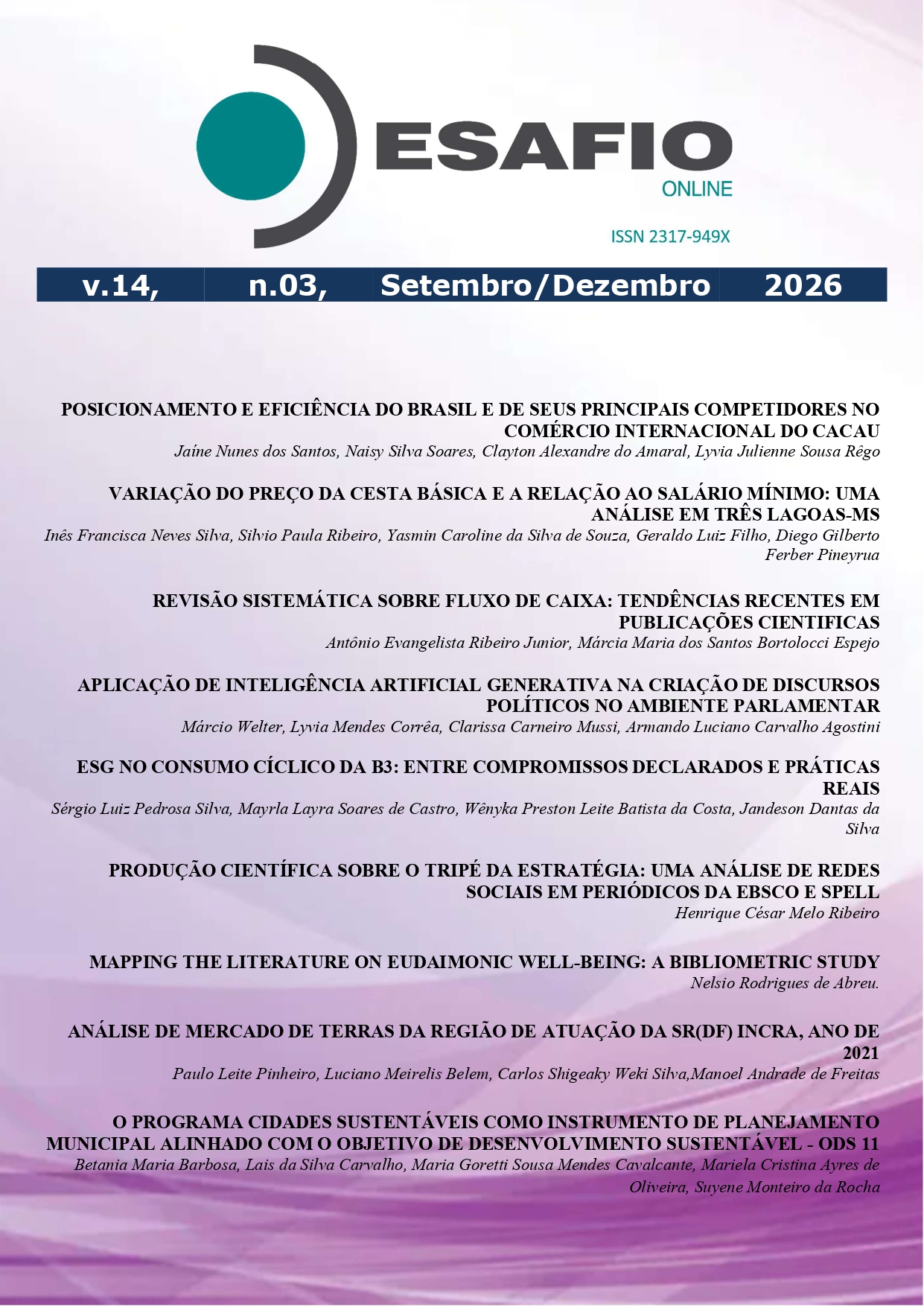
Descargas
Publicado
Número
Sección
Licencia
POLÍTICA DE DIREITOS AUTORAIS E CONFLITO DE INTERESSES
A Revista Desafio Online (DOn) baseia suas políticas éticas e normas nas diretrizes apresentadas pelo Comimittee on Publication Ethics – COPE (https://publicationethics.org/), em razão de seu compromisso com a qualidade editorial e ética científica.
Dever dos editores e equipe editorial:
- Decidir quais serão os artigos avaliados, baseados em sua qualidade, relevância acadêmica, conteúdo e adequação às diretrizes de submissão, sem discriminar, nenhum autor, por gênero, sexo, raça, orientação sexual, pensamento político, afiliação institucional, religião, naturalidade, nacionalidade, identidade étnico-cultural, ou outra forma de distinção social.
- Decidir e se responsabilizar pelos trabalhos que serão publicados (editor-chefe) seguindo as normas da política editorial, bem como os requisitos legais em vigor, no que se refere ao plágio, violação de direitos autorais e difamação.
- Não divulgar dados dos trabalhos além dos autores, pareceristas e membros do conselho editorial, zelando pela confidencialidade das informações.
- Não utilizar, ou se apropriar, do conteúdo original dos trabalhos submetidos, ainda não publicados.
- Não acompanhar o processo editorial do artigo em caso de existência de conflitos de interesses.
- Garantir que as submissões passem pelo processo de revisão duplo-cega (double-blind), sendo avaliado por, no mínimo, dois pareceristas.
- Atender aos princípios de boas práticas e transparência, averiguando condutas contrárias a estes, apresentando providências adequadas.
Dever dos pareceristas ad hoc:
- Auxiliar o corpo editorial, e os autores, no que tange a escolha das decisões editoriais, realizando a revisão sem qualquer tipo de distinção política, cultural, ou social, dos autores.
- Cumprir o prazo de resposta e data limite da avaliação, comunicando os editores nos casos de impossibilidade de realizar o trabalho.
- Abster-se de realizar a avaliação quando pouco capacitados ou não aptos, sobre o conteúdo do artigo. O declínio também deve ocorrer, na existência de qualquer conflito de interesses existente, por parte do avaliador.
- Respeitar o sigilo dos arquivos recebidos, sem que sejam divulgados, expostos ou conversados os conteúdos dos artigos, sem a permissão do editor-chefe, existindo a necessidade. O conteúdo dos trabalhos não deve ser utilizado para benefício próprio.
- Seguir os critérios de avaliação estipulados nas diretrizes, recomendando ajustes e melhorias, sem nunca realizar críticas ou ataques pessoais aos autores.
- Indicar referências de materiais adicionais que sejam pertinentes ao tema.
- Comunicar, aos editores, a existência de publicações anteriores, do mesmo trabalho.
- Os revisores serão incluídos na lista de pareceristas da Revista Desafio Online (DOn). Havendo a solicitação, eles podem receber uma Declaração de Avaliação formal, do Editor-Chefe. Para isso devem informar o nome completo e CPF, por e-mail.
Dever dos autores:
- Apresentar relatos precisos das submissões, com detalhes e referências necessárias à replicação, por terceiros. Dados implícitos devem ser precisamente apresentados, no artigo. Afirmações propositalmente incorretas, ou deturpadas, são tidas como má conduta ética, sendo inadmissíveis.
- Responsabilizar-se pela elaboração do material submetido, devendo o mesmo ser original, resguardando a autenticidade do conteúdo.
- Informar, através de citações adequadas, fontes de ideias e informações derivadas de outros trabalhos, evidenciando-as nas referências. A apropriação indevida de informações e trechos de trabalhos anteriormente publicados, sem a citação da fonte, se caracteriza como plágio e, nesses casos, o periódico se reserva o direito de rejeitar o trabalho, considerando tal prática antiética e inadmissível.
- Não submeter trabalhos que possuam, de forma substancial, a mesma investigação, para outros periódicos, ou mesmo que já tenha sido, anteriormente, publicado. Trabalhos publicados, anteriormente, em congressos serão aceitos para publicação apenas em caso de parcerias Fast Track com o evento. Artigos derivados de trabalhos de conclusão de curso, dissertações ou teses serão aceitos apenas mediante a inexistência de publicações em outros periódicos ou eventos, devendo, o autor principal, se responsabilizar pela indicação de outras autorias. A Revista Desafio Online respeita o prazo de 12 meses entre publicações de um mesmo autor.
- Atribuir a autoria do trabalho apenas àqueles que fizeram contribuições significativas em sua elaboração, sendo estes indicados como coautores, pelo autor principal, se responsabilizando, integralmente, pelo conteúdo. O autor principal deve fornecer os contatos de e-mails dos envolvidos, e certificar-se de que todos aprovaram a versão final do trabalho, consentindo com sua submissão.
- Declarar qualquer forma existente de conflitos de interesses, bem como apresentar toda e qualquer fonte de auxílio financeiro existente.
- Colaborar, com os editores, quanto à correção e atualização do seu artigo, através de erratas, ao identificar erros ou informações imprecisa que seja relevante na publicação.
- Atentar às decisões editoriais, e ao processo de avaliação e revisão, atendendo, o mais rápido possível, as requisições, mantendo seus dados cadastrados atualizados. Pede-se que as adequações sejam realizadas em até 30 dias, considerando o reenvio dos trabalhos.
- Disponibilizar, caso solicitado, os dados brutos da pesquisa, juntamente com o artigo, para revisão editorial. Os dados utilizados devem se manter acessíveis por, pelo menos, 10 anos após a publicação, considerando a proteção da confidencialidade dos autores, bem como os direitos jurídicos relacionados aos dados.
Arquivamento
A Revista Desafio Online utiliza o sistema LOCKSS. Este é um software livre desenvolvido pela Biblioteca da Universidade de Stanford, que permite preservar revistas online escolhidas ao sondar as páginas das mesmas por conteúdo recém publicado e arquivando-o. Cada arquivo é continuamente validado contra cópias de outras bibliotecas. Caso o conteúdo esteja corrompido ou perdido, as cópias são usadas para restauração.
ÉTICA E ANTIPLÁGIO
Os trabalhos submetidos à Revista Desafio Online (DOn) passarão por software detector de plágio (CopySpider), a qualquer momento, durante o processo editorial. Trabalhos que apresentem mais de 5% de similaridade com outras publicações não serão aceitos, de modo que tais submissões podem ser rejeitadas a qualquer momento, no processo editorial.
Os autores transferem todos os direitos autorais do artigo para a Revista Desafio Online. Qualquer reprodução, total ou parcial, em meios impressos ou eletrônicos, deverá ser solicitada por meio de autorização. A reprodução, caso autorizada, fará constar o competente registro e agradecimento à Revista.
Todos os artigos publicados, online e de livre acesso aos leitores, tem licença Creative Commons, de atribuição, uso não comercial e compartilhamento por ela.

As obras deste site estão licenciadas sob uma Licença Creative Commons Atribuição-NãoComercial-CompartilhaIgual 3.0 Brasil
PUBLICAÇÕES DA EQUIPE EDITORIAL
Não é permitida a submissão de trabalhos pelo editor-chefe e coeditores do periódico, garantindo a imparcialidade no processo editorial.
.jpg)
