
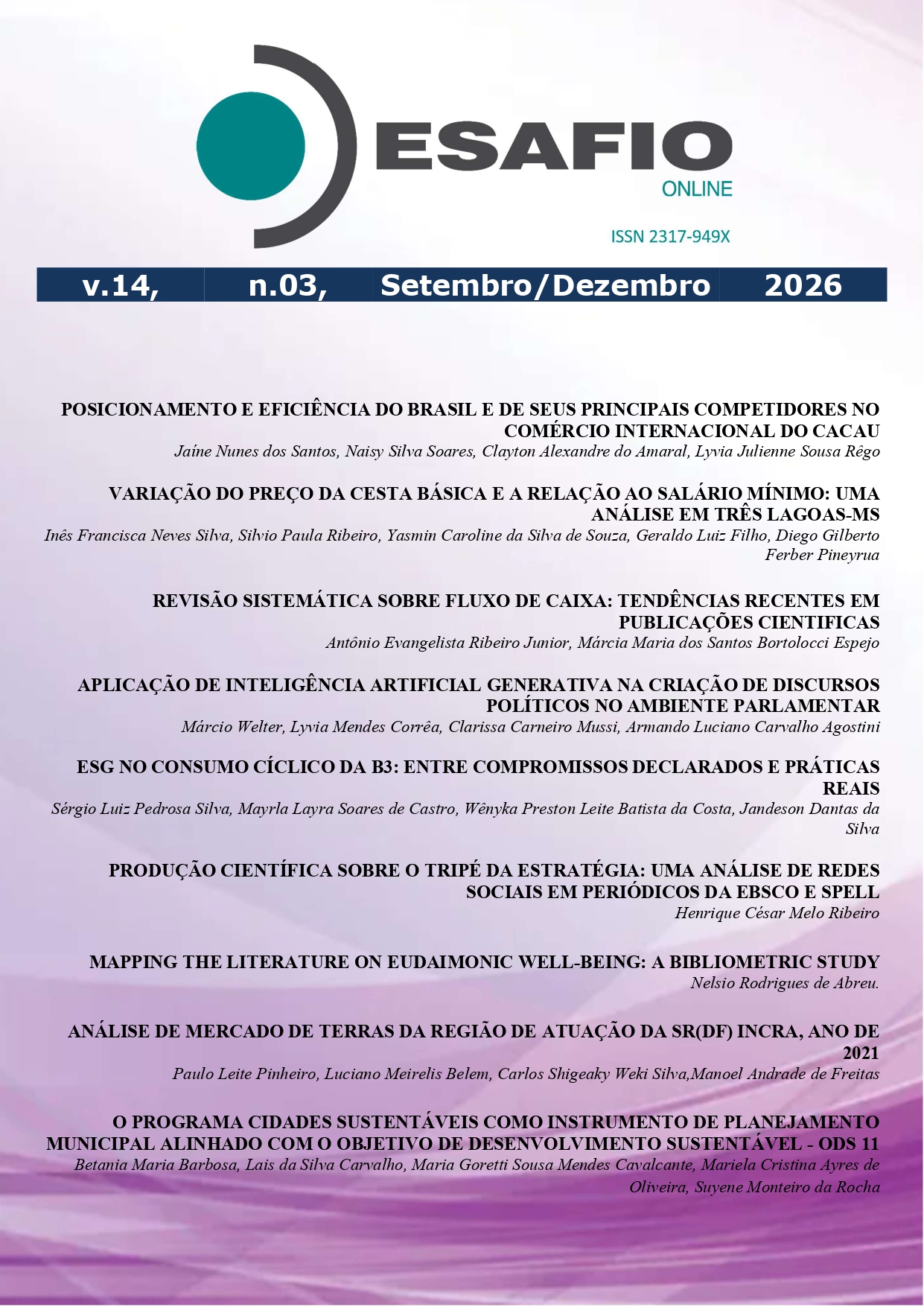
APLICAÇÃO DE INTELIGÊNCIA ARTIFICIAL GENERATIVA NA CRIAÇÃO DE DISCURSOS POLÍTICOS NO AMBIENTE PARLAMENTAR
DOI:
https://doi.org/10.55028/xdgjcm72Palavras-chave:
Tomada de Decisão, Inteigência Artificial Generativa, Parlamento, CanabidiolResumo
O estudo investiga a aplicação da Inteligência Artificial Generativa (IAG) no ambiente parlamentar, com o objetivo de melhorar a tomada de decisões para a formulação de políticas públicas. Explora como modelos de linguagem de larga escala (LLM) podem ser utilizados para gerar discursos políticos que subsidiem debates e decisões legislativas dentro de padrões aceitáveis de qualidade da informação. Quanto ao Design/Metodologia/Abordagem, a pesquisa foi estruturada em seleção e preparação dos dados, implementação do modelo de LLM/IAG, e verificação e validação dos resultados. A proposição legislativa escolhida foi a regulamentação do uso do Canabidiol, analisada a partir de discursos gerados por IA, os quais foram revisados por especialistas em apoio técnico legislativo. Revelou-se que a IAG pode contribuir no processamento, organização e análise de grandes volumes de informações no Parlamento, tornando-as mais acessíveis e compreensíveis. Como implicação prática, a utilização de IAG pode facilitar a automatização de tarefas legislativas. Isso pode liberar tempo de assessores e parlamentares para funções mais estratégicas. No que diz respeito a originalidade/valor, a pesquisa contribui para a literatura e aplicabilidade específica da IA no contexto do Poder Legislativo. Enquanto a literatura existente se concentra amplamente nos aspectos teóricos e nas aplicações de IA, este trabalho foca na sua aplicação prática e específica no ambiente parlamentar.
Referências
AGOSTINI, A. L. C. A inteligência artificial no poder público. In: SEMINÁRIO INTERNACIONAL- DEMOCRACIA E CONSTITUCIONALISMO, 13., 2020, Itajaí. Anais [...]. Itajaí: Universidade do Vale do Itajaí, 2020.
AHMET, Efe. The Impact of Artificial Intelligence on Social Problems and Solutions: An Analysis on The Context of Digital Divide and Exploitation. Yeni Medya Elektronik Dergi, v. 6, n. 2, p. 504-517, 2022. DOI: 10.55609/yenimedya.1146586.
ANDROUTSOPOULOU, A.; KARACAPILIDIS, N.; LOUKIS, E.; CHARALABIDIS, Y. Transforming the communication between citizens and government through AI-guided chatbots. Government information quarterly, v. 36, n. 2, p. 358-367, 2019.
ASSEMBLEIA LEGISLATIVA DO ESTADO DE SANTA CATARINA (ALESC). Tramitações da proposição zeVEK. 2023. Disponível em: https://portalelegis.alesc.sc.gov.br/proposicoes/zeVEK/tramitacoes. Acesso em: 7 abr. 2024.
BESLEY, T.; PRESTON, I. Accountability and political competition: Theory and evidence. Cambridge: Weather Center for International Affairs, Harvard University, 2002.
CÂMARA DOS DEPUTADOS. Consultoria Legislativa da Câmara utiliza Inteligência Artificial para agilizar trabalhos. Portal da Câmara dos Deputados, 9 ago. 2019. Disponível em: https://www.camara.leg.br/assessoria-de-imprensa/568452-consultoria-legislativa-da-camara-utiliza-inteligencia-artificial-para-agilizar-trabalhos/. Acesso em: 4 abr. 2024.
CHOWDHURY, S. et al. Unlocking the value of artificial intelligence in human resource management through AI capability framework. Human Resource Management Review, v. 33, n. 1, p. 100899, 2023.
COOMBS, C. et al. What is it about humanity that we can’t give away to intelligent machines? A European perspective. International Journal of Information Management, v. 58, p. 102311, 2021.
CREWE, E.; TAYLOR-ROBINSON, M. M.; MARTIN, S. The Future of Parliamentary and Legislative Studies. Parliamentary Affairs, v. 75, n. 4, p. 754-766, 2022.
DAVENPORT, T. H.; RONANKI, R. Artificial intelligence for the real world. Harvard business review, v. 96, n. 1, p. 108-116, 2018.
DE ANGELIS, L. et al. ChatGPT and the rise of large language models: the new AI-driven infodemic threat in public health. Frontiers in Public Health, v. 11, p. 1166120, 2023.
DORREN, L.; WOLF, E. E. How evidence-based policymaking helps and hinders policy conflict. Policy & Politics, v. 51, n. 3, p. 486-507, 2023.
DREHER, A.; LANG, V. F.; RICHERT, K. A economia política dos empréstimos da Corporação Financeira Internacional. Journal of Development Economics, v. 140, p. 242-254, 2019.
EBERL, J. M.; HUBER, R. A.; MEDE, N. G.; GREUSSING, E. Populist attitudes towards politics and science: how do they differ?. Political Research Exchange, v. 5, n. 1, p. 2159847, 2023.
ELOUNDOU, T.; MANNING, S.; MISHKIN, P.; ROCK, D. Gpts are gpts: An early look at the labor market impact potential of large language models. arXiv, 2303.10130, 2023.
ENHOLM, I. M.; PAPAGIANNIDIS, E.; MIKALEF, P.; KROGSTIE, J. Artificial intelligence and business value: A literature review. Information Systems Frontiers, v. 24, n. 5, p. 1709-1734, 2022.
FILGUEIRAS, F. Running for artificial intelligence policy in G20 Countries-Policy instruments and mixes matters? Revista Brasileira de Inovação, v. 21, e022016, 2022.
FLORIDI, L.; CHIRIATTI, M. GPT-3: Its Nature, Scope, Limits, and Consequences. Minds and Machines, v. 30, n. 4, p. 681-694, 2020.
GIL, O.; CORTÉS-CEDIEL, M.; CANTADOR, I. Citizen Participation and the Rise of Digital Media Platforms in Smart Governance and Smart Cities. International Journal of E-Planning Research, v. 8, p. 19-34, 2019. DOI: 10.4018/IJEPR.2019010102.
HERTEL-FERNANDEZ, A.; MILDENBERGER, M.; STOKES, L. C. Legislative Staff and Representation in Congress. American Political Science Review, v. 113, n. 3, p. 622-636, 2019.
HOSSIN, M. A. et al. Big Data-Driven Public Policy Decisions: Transformation Toward Smart Governance. Sage Open, v. 13, n. 4, 2023. DOI: 10.1177/21582440231215123.
HOVY, E.; LAVID, J. Towards a ‘science’ of corpus annotation: a new methodological challenge for corpus linguistics. International journal of translation, v. 22, n. 1, p. 13-36, 2010.
IBEH, Chidera Victoria; ADEGBOLA, Ayodeji. AI and Machine Learning for Sustainable Energy: predictive modelling, optimization and socioeconomic impact in the usa. International Journal Of Applied Sciences And Radiation Research, [S.L.], v. 2, n. 1, p. 23-32, 14 mar. 2025. Iskender AKKURT. http://dx.doi.org/10.22399/ijasrar.19.
KAHNEMAN, D.; TVERSKY, A. Prospect theory: An analysis of decision under risk. In: LEE, C. F.; LEE, A. C. (Ed.). Handbook of the fundamentals of financial decision making: Part I. Singapore: World Scientific Publishing, 2013. p. 99-127.
KORYZIS, D. et al. Disruptive technologies for parliaments: A literature review. Future Internet, v. 15, n. 2, p. 66, 2023.
LINDBLOM, C. E. The science of “muddling through”. Public Administration Review, v. 19, n. 2, p. 79-88, 1959.
MATHEUS, R.; JANSSEN, M.; JANOWSKI, T. Design principles for creating digital transparency in government. Government Information Quarterly, v. 38, n. 1, p. 101550, 2021.
MELLADO, B. et al. Leveraging artificial intelligence and big data to optimize COVID-19 clinical public health and vaccination roll-out strategies in Africa. International Journal of Environmental Research and Public Health, v. 18, n. 15, p. 7890, 2021.
MILLER, H. The multiple dimensions of information quality. Information Systems Management, v. 13, n. 2, p. 79-82, 1996. DOI: 10.1080/10580539608906992.
MINTZBERG, H.; RAISINGHANI, D.; THÉORÊT, A. The Structure of “Unstructured” Decision Processes. Administrative Science Quarterly, v. 21, n. 2, p. 246-275, 1976.
NAVEED, H. et al. A comprehensive overview of large language models. arXiv, 2307.06435, 2023.
OOI, K. B. et al. The potential of generative artificial intelligence across disciplines: Perspectives and future directions. Journal of Computer Information Systems, p. 1-32, 2023.
PAN, Y.; OKAZAKI, N.; INUI, K. Leveraging Large Amounts of Weakly Supervised Data for Multi-Language Sentiment Classification. Journal of Artificial Intelligence Research, v. 67, p. 569-606, 2020.
RAMOS, A. S. M. Inteligência Artificial Generativa baseada em grandes modelos de linguagem: ferramentas de uso na pesquisa acadêmica. SciELO Preprints, 2023. DOI: 10.1590/scielopreprints.6105.
SIMON, H. A. Models of Man: Social and Rational; Mathematical Essays on Rational Human Behavior in a Social Setting. New York: Wiley, 1957.
ULNICANE, I. Artificial Intelligence in the European Union: Policy, ethics and regulation. In: CHRISTIANSEN, T.; VANHOONACKER, S. (Ed.). The Routledge handbook of European integrations. London: Taylor & Francis, 2022.
WAMBA-TAGUIMDJE, S. L. et al. Influence of artificial intelligence (AI) on firm performance: the business value of AI-based transformation projects. Business Process Management Journal, v. 26, n. 7, p. 1893-1924, 2020. DOI: 10.1108/BPMJ-10-2019-0411.
WELTER, M.; CORRÊA, L.; GONÇALVES, A. Análise de agrupamentos em discursos políticos no parlamento. In: INTERNATIONAL CONFERENCE ON INFORMATION SYSTEMS AND TECHNOLOGY MANAGEMENT (CONTECSI), 17., 2020, São Paulo. Anais [...]. São Paulo: TECSI-FEA-USP, 2020.
WELTER, M.; GONÇALVES, A.; ALVES, J. B. Networks Analysis in Topics Clusters of Political Speech in Parliament. In: INTERNATIONAL CONFERENCE ON INFORMATION SYSTEMS AND TECHNOLOGY MANAGEMENT (CONTECSI), 18., 2021, Evento virtual. Anais [...]. São Paulo: TECSI-FEA-USP, 2021.
Downloads
Publicado
Edição
Seção
Licença
POLÍTICA DE DIREITOS AUTORAIS E CONFLITO DE INTERESSES
A Revista Desafio Online (DOn) baseia suas políticas éticas e normas nas diretrizes apresentadas pelo Comimittee on Publication Ethics – COPE (https://publicationethics.org/), em razão de seu compromisso com a qualidade editorial e ética científica.
Dever dos editores e equipe editorial:
- Decidir quais serão os artigos avaliados, baseados em sua qualidade, relevância acadêmica, conteúdo e adequação às diretrizes de submissão, sem discriminar, nenhum autor, por gênero, sexo, raça, orientação sexual, pensamento político, afiliação institucional, religião, naturalidade, nacionalidade, identidade étnico-cultural, ou outra forma de distinção social.
- Decidir e se responsabilizar pelos trabalhos que serão publicados (editor-chefe) seguindo as normas da política editorial, bem como os requisitos legais em vigor, no que se refere ao plágio, violação de direitos autorais e difamação.
- Não divulgar dados dos trabalhos além dos autores, pareceristas e membros do conselho editorial, zelando pela confidencialidade das informações.
- Não utilizar, ou se apropriar, do conteúdo original dos trabalhos submetidos, ainda não publicados.
- Não acompanhar o processo editorial do artigo em caso de existência de conflitos de interesses.
- Garantir que as submissões passem pelo processo de revisão duplo-cega (double-blind), sendo avaliado por, no mínimo, dois pareceristas.
- Atender aos princípios de boas práticas e transparência, averiguando condutas contrárias a estes, apresentando providências adequadas.
Dever dos pareceristas ad hoc:
- Auxiliar o corpo editorial, e os autores, no que tange a escolha das decisões editoriais, realizando a revisão sem qualquer tipo de distinção política, cultural, ou social, dos autores.
- Cumprir o prazo de resposta e data limite da avaliação, comunicando os editores nos casos de impossibilidade de realizar o trabalho.
- Abster-se de realizar a avaliação quando pouco capacitados ou não aptos, sobre o conteúdo do artigo. O declínio também deve ocorrer, na existência de qualquer conflito de interesses existente, por parte do avaliador.
- Respeitar o sigilo dos arquivos recebidos, sem que sejam divulgados, expostos ou conversados os conteúdos dos artigos, sem a permissão do editor-chefe, existindo a necessidade. O conteúdo dos trabalhos não deve ser utilizado para benefício próprio.
- Seguir os critérios de avaliação estipulados nas diretrizes, recomendando ajustes e melhorias, sem nunca realizar críticas ou ataques pessoais aos autores.
- Indicar referências de materiais adicionais que sejam pertinentes ao tema.
- Comunicar, aos editores, a existência de publicações anteriores, do mesmo trabalho.
- Os revisores serão incluídos na lista de pareceristas da Revista Desafio Online (DOn). Havendo a solicitação, eles podem receber uma Declaração de Avaliação formal, do Editor-Chefe. Para isso devem informar o nome completo e CPF, por e-mail.
Dever dos autores:
- Apresentar relatos precisos das submissões, com detalhes e referências necessárias à replicação, por terceiros. Dados implícitos devem ser precisamente apresentados, no artigo. Afirmações propositalmente incorretas, ou deturpadas, são tidas como má conduta ética, sendo inadmissíveis.
- Responsabilizar-se pela elaboração do material submetido, devendo o mesmo ser original, resguardando a autenticidade do conteúdo.
- Informar, através de citações adequadas, fontes de ideias e informações derivadas de outros trabalhos, evidenciando-as nas referências. A apropriação indevida de informações e trechos de trabalhos anteriormente publicados, sem a citação da fonte, se caracteriza como plágio e, nesses casos, o periódico se reserva o direito de rejeitar o trabalho, considerando tal prática antiética e inadmissível.
- Não submeter trabalhos que possuam, de forma substancial, a mesma investigação, para outros periódicos, ou mesmo que já tenha sido, anteriormente, publicado. Trabalhos publicados, anteriormente, em congressos serão aceitos para publicação apenas em caso de parcerias Fast Track com o evento. Artigos derivados de trabalhos de conclusão de curso, dissertações ou teses serão aceitos apenas mediante a inexistência de publicações em outros periódicos ou eventos, devendo, o autor principal, se responsabilizar pela indicação de outras autorias. A Revista Desafio Online respeita o prazo de 12 meses entre publicações de um mesmo autor.
- Atribuir a autoria do trabalho apenas àqueles que fizeram contribuições significativas em sua elaboração, sendo estes indicados como coautores, pelo autor principal, se responsabilizando, integralmente, pelo conteúdo. O autor principal deve fornecer os contatos de e-mails dos envolvidos, e certificar-se de que todos aprovaram a versão final do trabalho, consentindo com sua submissão.
- Declarar qualquer forma existente de conflitos de interesses, bem como apresentar toda e qualquer fonte de auxílio financeiro existente.
- Colaborar, com os editores, quanto à correção e atualização do seu artigo, através de erratas, ao identificar erros ou informações imprecisa que seja relevante na publicação.
- Atentar às decisões editoriais, e ao processo de avaliação e revisão, atendendo, o mais rápido possível, as requisições, mantendo seus dados cadastrados atualizados. Pede-se que as adequações sejam realizadas em até 30 dias, considerando o reenvio dos trabalhos.
- Disponibilizar, caso solicitado, os dados brutos da pesquisa, juntamente com o artigo, para revisão editorial. Os dados utilizados devem se manter acessíveis por, pelo menos, 10 anos após a publicação, considerando a proteção da confidencialidade dos autores, bem como os direitos jurídicos relacionados aos dados.
Arquivamento
A Revista Desafio Online utiliza o sistema LOCKSS. Este é um software livre desenvolvido pela Biblioteca da Universidade de Stanford, que permite preservar revistas online escolhidas ao sondar as páginas das mesmas por conteúdo recém publicado e arquivando-o. Cada arquivo é continuamente validado contra cópias de outras bibliotecas. Caso o conteúdo esteja corrompido ou perdido, as cópias são usadas para restauração.
ÉTICA E ANTIPLÁGIO
Os trabalhos submetidos à Revista Desafio Online (DOn) passarão por software detector de plágio (CopySpider), a qualquer momento, durante o processo editorial. Trabalhos que apresentem mais de 5% de similaridade com outras publicações não serão aceitos, de modo que tais submissões podem ser rejeitadas a qualquer momento, no processo editorial.
Os autores transferem todos os direitos autorais do artigo para a Revista Desafio Online. Qualquer reprodução, total ou parcial, em meios impressos ou eletrônicos, deverá ser solicitada por meio de autorização. A reprodução, caso autorizada, fará constar o competente registro e agradecimento à Revista.
Todos os artigos publicados, online e de livre acesso aos leitores, tem licença Creative Commons, de atribuição, uso não comercial e compartilhamento por ela.

As obras deste site estão licenciadas sob uma Licença Creative Commons Atribuição-NãoComercial-CompartilhaIgual 3.0 Brasil
PUBLICAÇÕES DA EQUIPE EDITORIAL
Não é permitida a submissão de trabalhos pelo editor-chefe e coeditores do periódico, garantindo a imparcialidade no processo editorial.
.jpg)
